

In short
Pick a deburring disc by the result you need on the part. Compact or heavy deburring discs take off burrs, a combi disc rounds sharp edges, a flex disc handles 3D parts, a wire disc removes oxide and an eccentric disc gives a non-directional look.
Material, cutting method and part shape narrow the choice to a few options, and the final decision is made on a sample part.
Why can one disc not do every job?

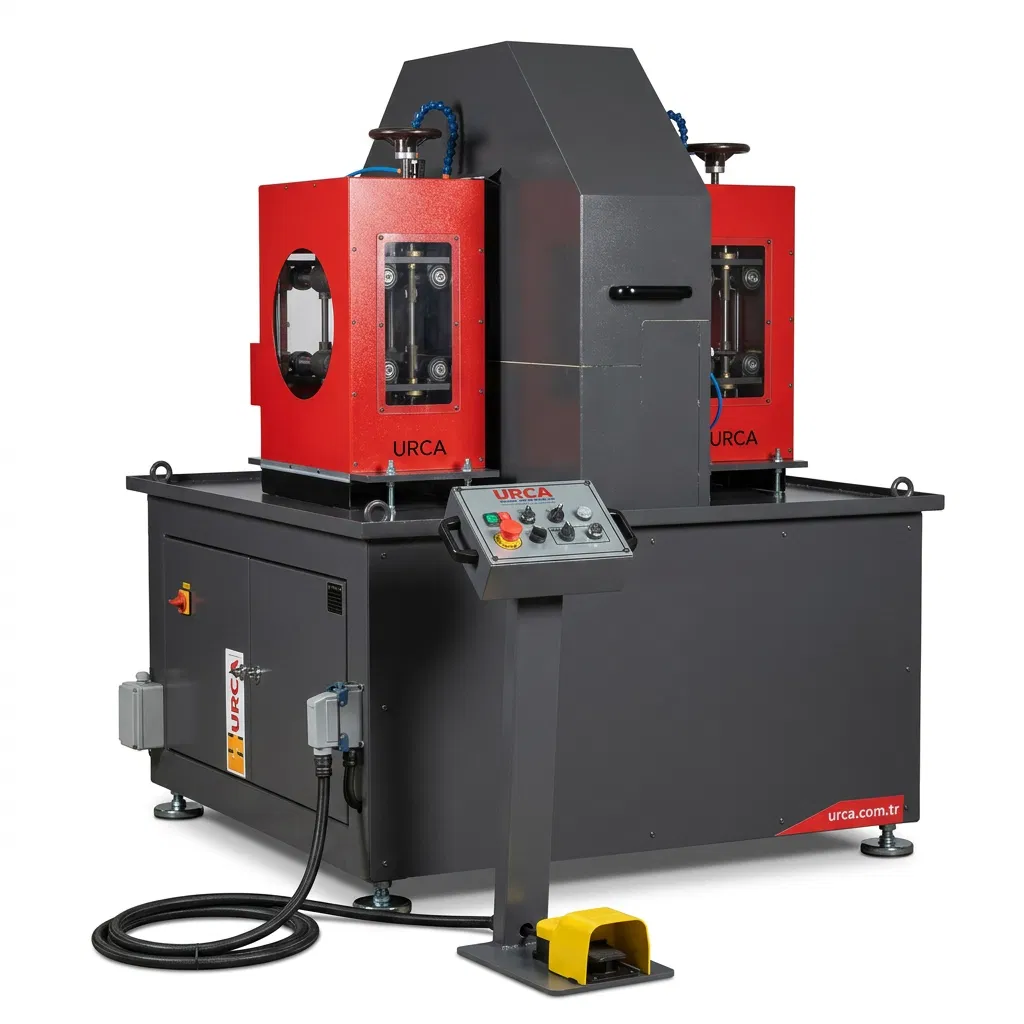
On a disc-based machine, the disc is what touches the part. A stiff, aggressive disc removes a heavy burr fast but can mark the surface; a flexible disc follows the edge and touches the flat face less. So the right disc differs from part to part. On the Urca QB1350 4-disc machine the discs are interchangeable: two stations sit at the front and two at the rear, so two different discs can run at the same time. The list below comes from the published product page.

Which disc does which job?
- Compact disc: burrs and weld spatter; the product page highlights it for heavy burrs on stainless steel.
- Scotch-Brite disc: gentler; for light deburring and finishing on laser cut aluminium or steel.
- Heavy deburring disc: thick burr and slag from plasma and oxy-fuel cutting.
- Combi disc: edge rounding. The product page calls it the go-to disc for this on all material types. On stamped, foiled or galvanised 3D parts the flex disc takes over.
- Wire disc: removes the dark oxide layer on oxygen cut steel.
- Eccentric disc: a non-directional finish for visible panels and an even surface before coating.
Which disc for which situation? A selection table
Disc selection table
| What you see on the part | Suggested disc (QB1350) |
|---|---|
| Laser cut, light burr, visible surface | Scotch-Brite disc |
| Weld spatter or heavy burr on stainless | Compact disc |
| Plasma or oxy-fuel cut, thick burr and slag | Heavy deburring disc |
| Sharp edge before painting | Combi disc |
| Stamped, deep drawn, foiled or galvanised part | Flex disc |
| Dark cut edge on oxygen cut steel | Wire disc |
| Even, non-directional look | Eccentric disc |
Treat the table as a starting point. When one part has more than one problem, slag and a sharp edge for example, confirm the order of operations on a sample.
What should you watch for by material?
On stainless steel, appearance often sells the part, so avoid unnecessary marks. Running stainless and carbon steel with the same consumables can stain stainless, which is why keeping them separate is good practice.
For aluminium and black sheet, the product page says the machine roughens the surface in a controlled way before painting, which helps coating adhesion. Aluminium dust needs its own attention; our dust control guide covers it. On galvanised and foiled parts the flex disc usually fits better.
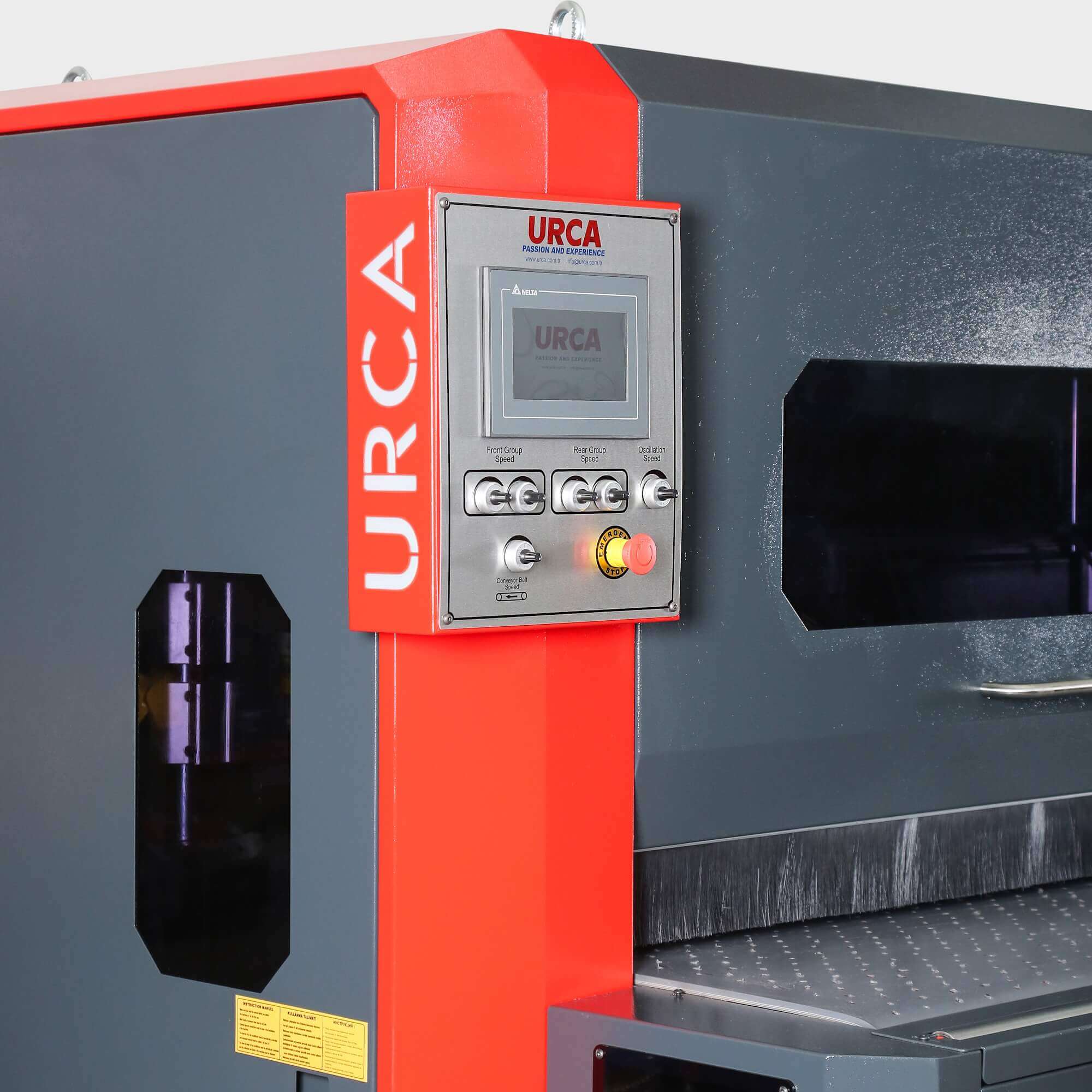
The vacuum-supported conveyor of the QB1350 holds parts of 2 mm and thinner in place, which cuts down slipping and vibration. If a part moves, even the right disc will not give the same result along every edge.
How do you confirm the disc choice on a sample?
A choice that looks right on paper can behave differently on a real part. Run a few parts and check leftover burrs, holes versus the outer edge, marks on the visible face, and coating hold after painting. Write down the disc, feed and settings. On the QB1350, feed is adjustable from 0.5 to 6 m/min and disc speed is adjustable too.
What to send for a quote or sample test
What to send for a quote or sample
- Material and thickness range
- Cutting method (laser, plasma, oxy-fuel, punching)
- Photos of both faces and the edge
- Goal: deburring, edge rounding, oxide removal, non-directional finish or pre-paint preparation
- Daily or monthly volume
For help with machine use and process settings, see our service and technical support page.
Frequently asked questions
Which disc is used for deburring?
For light burrs on laser cut parts, the Scotch-Brite disc. For heavy burrs and weld spatter on stainless, the compact disc. For thick burrs and slag from plasma or oxy-fuel cutting, the heavy deburring disc.
Which disc is most suitable for edge rounding?
The combi disc on flat sheet parts, and the flex disc on stamped, deep drawn or foiled 3D parts.
How do you remove oxide from laser cut steel?
On the QB1350, oxide on oxygen cut steel is removed with the wire disc.
What is a non-directional finish?
A finish with no grain running in one direction, so the surface looks the same from every angle. On the QB1350 it is produced with the eccentric disc.
Can different discs be used on the same machine?
Yes. The QB1350 has two disc stations at the front and two at the rear, so two different discs can be used at the same time. The right combination for a part is confirmed with a sample test.
Want a disc recommendation for your part?
Send the material, thickness, cutting method and the edge condition you need. For a sample assessment, attach a photo of the part. Phone: +90 224 362 06 47.