

In short
Deburring removes the thin ridge of material (the burr) left on an edge after cutting or punching. Edge rounding gives the still-sharp, burr-free corner a small radius.
Parts that will be painted, handled or bent usually need both: deburr first, then round the edge.
In this article
- What is a burr and why does it form on sheet metal?
- What is edge rounding and how is it different from deburring?
- Which sheet metal part needs which?
- How do you deburr and round edges with the QB1350?
- When is hand deburring enough and when do you need a machine?
- What to prepare before asking for a quote
- Frequently asked questions
What is a burr and why does it form on sheet metal?
During cutting, some of the material stays on the underside as a thin ridge: the burr. It can cut a hand, stop parts seating in bending and assembly, and keep paint from holding on the edge.
On laser-cut parts the burr is usually thin, but the edge is not burr-free. For the dark oxide on oxygen cut steel the QB1350 product page points to a wire disc; for thick burr and slag from plasma and oxy-fuel cutting, to the heavy deburring disc.
What is edge rounding and how is it different from deburring?
Edge rounding turns the sharp corner on the outer contour and on hole edges into a small, even curve. Even after deburring the edge stays sharp: it cuts when handled and paint thins on the corner. The drawing and the next process decide the radius, so we do not quote a general value here.
Deburring vs edge rounding comparison
| Feature | Deburring | Edge rounding |
|---|---|---|
| Goal | Remove excess material from the edge | Give the sharp corner a controlled radius |
| When | Right after cutting, the first step | After the burr is removed |
| Typical QB1350 disc | Compact disc, Scotch-Brite disc, heavy deburring disc | Combi disc; flex disc on 3D parts |
| Result | A flat edge with nothing sticking out | An edge that is safe to handle and ready for paint |
Deburring cleans the edge; edge rounding shapes it, usually in that order.
Which sheet metal part needs which?
Look at where the part goes after cutting:
- Parts to be painted or powder coated: both. If the edge is not rounded, the paint thins out on the corner.
- Parts to be welded: deburring first. On oxygen cut steel, remove the oxide layer on the edge as well.
- Parts to be bent: deburring, so the die and the part are not damaged.
- Parts carried by hand or sent to the end user: edge rounding, for safety and feel.
Worth knowing
If you are not sure, photos of both faces and the cut edge are usually enough.
How do you deburr and round edges with the QB1350?

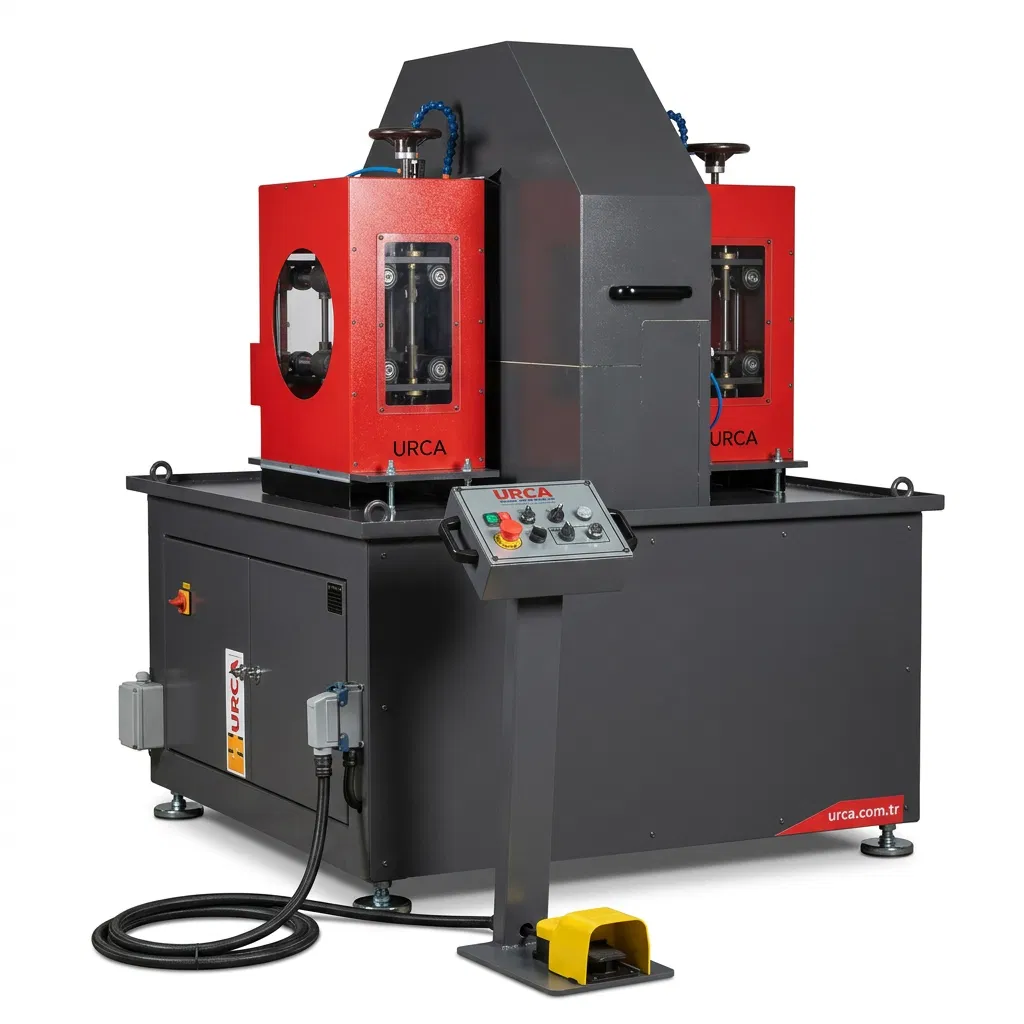
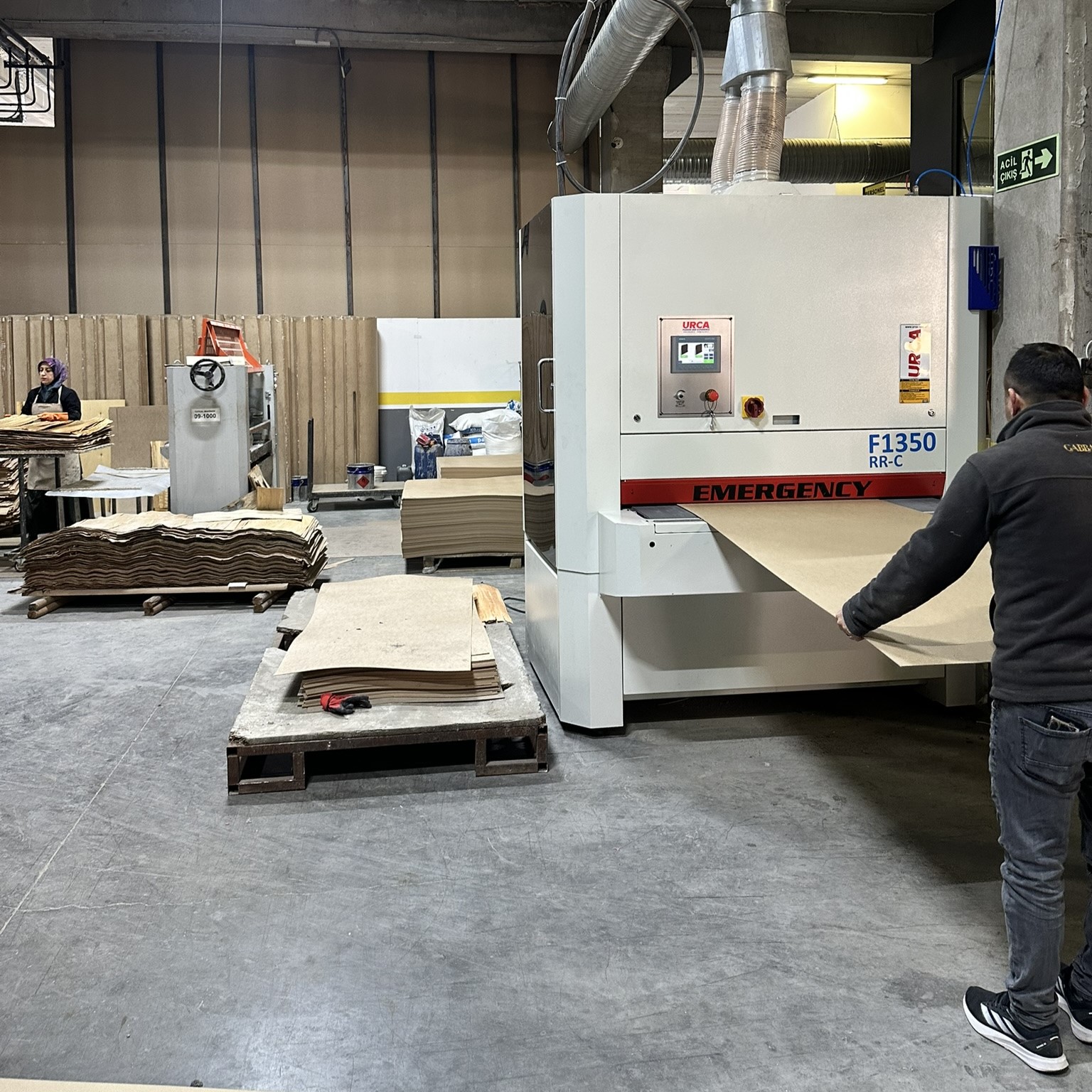
You do not need two machines. Urca’s QB1350 4-disc deburring and edge rounding machine does both on one platform, depending on the disc fitted. Product-page values: 1350 mm working width, 4 discs of Ø250 mm, adjustable disc speed and a feed speed of 0.5 to 6 m/min. The machine works with stainless steel, carbon steel, aluminium, galvanised and black sheet.
Which disc does what?

The machine has two disc stations at the front and two at the rear, so two different discs can run at the same time. The seven disc types are below.
Disc types and their uses
- Compact disc: burrs and weld spatter.
- Scotch-Brite disc: light deburring and finishing.
- Combi disc: edge rounding.
- Flex disc: edge rounding on 3D, stamped and shaped parts.
- Wire disc: oxide after laser cutting.
- Heavy deburring disc: thick burrs and slag after plasma and oxy-fuel cutting.
- Eccentric disc: non-directional finish.
We cover disc selection in more detail in a separate post: disc selection for sheet metal.
The QB1350 vacuum-supported conveyor holds parts of 2 mm and thinner, reducing vibration and movement. For other models, see our deburring machine and edge rounding machine pages.

When is hand deburring enough and when do you need a machine?
For a few parts or a one-off job, a hand tool does the work. As volume grows, time and repeatability become the problem; an even radius is hard to hold by hand. Parts waiting at the station, paint lifting at the edges, or a radius on the drawing are signs it is time to look at a machine.
What to prepare before asking for a quote
What to prepare for a quote
- Material (stainless, carbon steel, aluminium, galvanised)
- Sheet thickness range and largest part size
- Cutting method (laser, plasma, oxy-fuel, punching)
- Next process (paint, welding, bending, assembly)
- Edge condition required on the drawing
- Photos of both faces of the part
Frequently asked questions
Are deburring and edge rounding the same process?
No. Deburring removes the excess material on the edge, while edge rounding gives the remaining sharp corner a controlled radius. The usual order is deburring first, then edge rounding.
Do laser cut parts need edge rounding?
If the part will be painted, handled by hand or the drawing calls for a radius, yes. Even when the burr from laser cutting is small, the edge stays sharp and the paint thins out on the corner.
Which disc removes plasma cut burrs?
The heavy deburring disc is used for the thick burr and slag from plasma and oxy-fuel cutting. Starting with a disc made for light burrs is not efficient.
Does deburring remove the oxide layer?
The oxide layer on oxygen cut steel is a separate process. On the QB1350 a wire disc is used for it.
Which materials does the QB1350 work with?
According to the product page, stainless steel, carbon steel, aluminium, galvanised and black sheet. For another material, we assess it on a sample.
Do thin sheets slip on the machine?
The QB1350 vacuum-supported conveyor holds parts of 2 mm and thinner in place, reducing slipping and vibration.
Tell us about your part and we will look at it together
Send the material, thickness and cutting method, and attach photos of both faces and the cut edge. Phone: +90 224 362 06 47.